
Tour guide system - what is it and how does it work?
A tour guide system is a wireless set for guiding groups: the guide speaks into a small transmitter, and participants listen through receivers with earphones. We explain what it's made of, how it works, how it differs from an audio guide (audio guide, museum system) and from a portable speaker, and how much it costs to rent.
Transmitter for the guide
A small device with a microphone that the guide carries. In the Okayo WT-300D it weighs 110 g and fits in your hand.
Receivers for participants
Every participant gets a receiver with an earphone and a neck strap. The receiver weighs 110 g and runs up to 35 hours on a single set of batteries.
Radio channels
The set operates on 25 UHF channels. Several groups can work side by side - each on its own channel, without interfering with one another.
Range up to 100 metres
The group doesn't need to huddle around the guide. Participants can stand freely, look at an exhibit up close, and still hear everything.
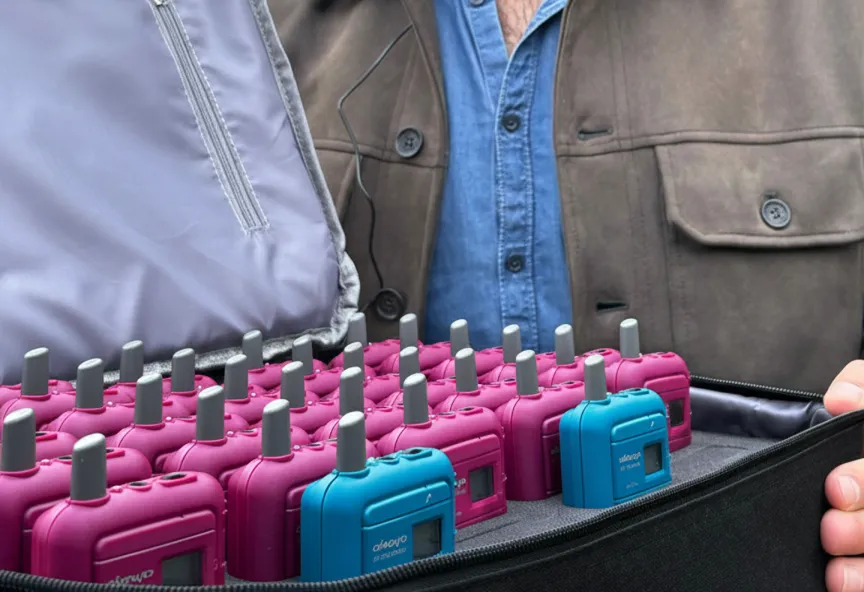
🎧 What is a tour guide system?
A tour guide system (also called a "tourguide set" or a group-guiding/guide system; in Poland this same product is also searched for as "system TGS") is a wireless audio set made up of one transmitter and any number of receivers.
The guide speaks into a microphone clipped to the transmitter - in a normal, quiet voice. The signal travels by radio straight to the receivers, which participants wear around their neck with an earphone in their ear. The effect is as if the guide were standing right next to every person in the group, whether they're at the front or twenty metres away.
It's a purely communication-focused solution: it doesn't amplify the surroundings, doesn't play recordings, and requires no installation at the venue.
⚙️ How does a tour guide system work in practice?
It's remarkably simple to use, which is one of the reasons these sets have caught on in the tourism industry.
1. The guide switches on the transmitter and clips on the microphone.
2. Participants switch on their receivers and put on the earphones.
3. That's it - the devices are paired at the factory and run on a shared channel.
If the group splits into smaller ones, or several tours are running in the same place, the guide switches the channel for their whole group directly from the transmitter. Participants don't need to change anything - a feature most cheaper sets on the market don't offer.
🆚 How does a tour guide system differ from an audio guide?
These two solutions are often confused, yet they answer completely different needs.
An audio guide - also called an audioguide or a museum system - is a playback device with a recording. The visitor picks an exhibit number and listens to a pre-recorded track. There's no live person involved - and no way to ask a question.
A tour guide system transmits a specific guide's voice live. The narration adapts to the group, the pace of the visit and the weather, and participants can interact with the guide.
In short: an audio guide replaces the guide, while a tour guide system finally makes the guide audible. If you're looking for recordings for self-guided visits, that's not what this is for. If you have a person leading the group, this is exactly what you need.
🔊 Tour guide system vs. a portable speaker for guides
This is the most common dilemma for guides shopping for sound equipment: a mobile speaker with a microphone (megaphone, portable PA set) or a tour guide system? The difference is fundamental, because these devices work in opposite directions.
A portable speaker amplifies the surroundings. Your group hears it, but so does everyone around: other tours, passers-by, restaurant guests, other visitors. To cut through street noise of around 80-85 dB, you have to be louder than it - which means you become the loudest thing in the area.
A tour guide system sends sound straight to each participant's ear. You speak in a normal, quiet voice, and the whole group still hears you. The surroundings hear nothing.
What this means in practice:
- Museums, churches, heritage sites - speakers are usually simply banned or frowned upon there. A tour guide system is a condition of entry for groups at many venues.
- Several groups in one place - speakers drown each other out; tour guide systems run side by side on separate channels.
- Echo - indoors, a speaker makes things worse by adding reverberation. An earphone is completely unaffected by echo.
- Range - with a speaker, the group has to stay close to the sound source. With a tour guide system, they get 100 metres of freedom.
- Your voice - with a speaker you still end up talking louder than normal, because you're competing with the surroundings. With a tour guide set you can speak in a whisper.
When is a speaker the better choice? When the audience is undefined or changing - an outdoor event, announcements to a random crowd, a short address to a large crowd you can't hand receivers out to. But if you're guiding a specific, countable group, a tour guide system wins on every point above.
📍 Where does a tour guide system work well?
- City tours - street noise on tourist routes reaches 80-85 dB, and a guide's unaided voice doesn't carry further than 3-5 metres.
- Museums, churches and heritage sites - there the problem is the opposite: you need to speak more quietly so as not to disturb others.
- Industrial facility tours - machine noise makes normal conversation impossible.
- Conferences, training sessions and study visits - when the group moves between rooms.
- Simultaneous interpretation without a booth - the interpreter speaks on a separate channel, and listeners pick their language.
💰 How much does renting a tour guide system cost?
With us, rental costs 12 PLN gross (incl. 23% VAT) per receiver for the first day, and just 4 PLN gross for every following day. Two days is 16 PLN, three days 20 PLN. The transmitter, neck straps, 2-in-1 transport bag/backpack and 1 disposable earphone per receiver are all included in the price (extra earphones: 1.50 PLN gross each).
Self-pickup and return at our location are free; delivery to your address costs 30 PLN gross (incl. 23% VAT) anywhere in Poland. The minimum order value is 250 PLN gross. We issue a 23% VAT invoice - just provide your company's tax ID (NIP).
Frequently Asked Questions
Tour guide system - what is it?
expand_more
Tour guide system - what is it?
It's a wireless set for guiding groups, made up of a transmitter for the guide and receivers with earphones for participants. The guide's voice travels by radio straight to each person's ear in the group, without raising your voice and without amplifying the surroundings.
How does a tour guide system work?
expand_more
How does a tour guide system work?
The guide speaks into a microphone on the transmitter, and participants' receivers pick up the radio signal. The devices are paired at the factory, so using them just means switching them on. The guide can switch the channel for the whole group at any time, directly from the transmitter.
How does a tour guide system differ from an audio guide?
expand_more
How does a tour guide system differ from an audio guide?
An audio guide (audioguide, museum system) plays a pre-recorded track and replaces the guide. A tour guide system transmits a specific guide's voice live, so the narration adapts to the group and participants can ask questions.
Is a tour guide system better than a portable speaker for guides?
expand_more
Is a tour guide system better than a portable speaker for guides?
For guiding a specific group - yes. A speaker amplifies the whole surrounding area, so other tours and passers-by hear it too, and museums and churches usually don't allow it. A tour guide system sends sound straight to each participant's ear, so you can speak more quietly, disturb no one, and work at a range of up to 100 metres. A speaker only has the edge when the audience is random and you can't hand out receivers.
How many receivers do I need?
expand_more
How many receivers do I need?
One per participant, plus one transmitter per guide. For a group of 40 with one guide, that's 40 receivers and 1 transmitter. If the group splits into smaller ones, each subgroup gets its own transmitter and channel.
Need a set for a specific date?
Tell us how many participants you have and when - we'll check availability and send you a quote.
Check availability